
If you have been asked to interview with Renari, you are probably wondering who we are and why you are not talking to the company you applied to.
Short version: the company you applied to has asked us to run the interview on their behalf. We are not a recruiter. We are not deciding whether you get the job. We interview you, score you against the same criteria as every other candidate for that role and give the company an evidenced report. They make the decision.
Here is exactly what happens, and how to prepare for it properly.
What the interview actually looks like
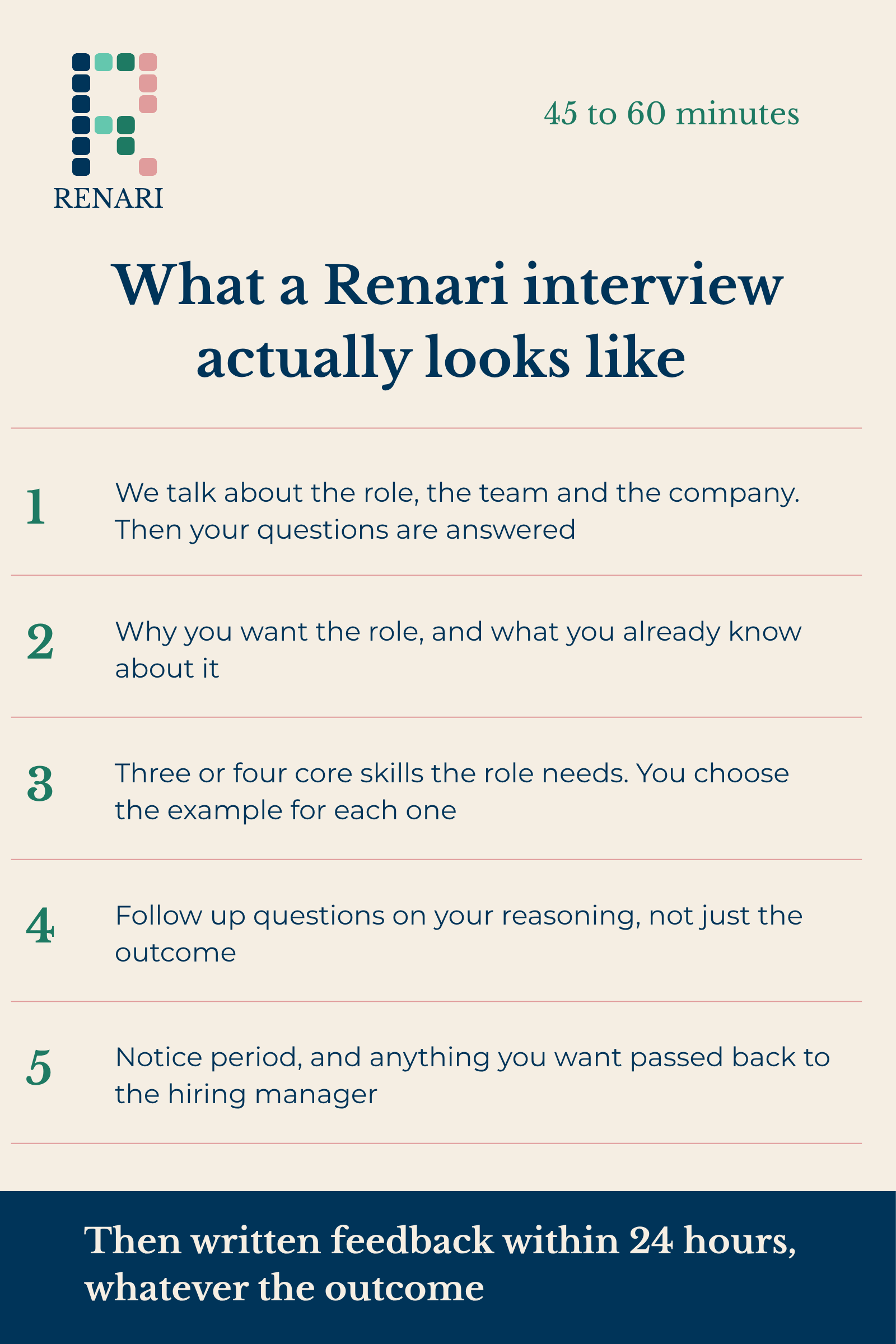
It lasts 45 to 60 minutes, by video unless you have been told otherwise.
We open with a short introduction to the role, the team and the company. This is not filler. We are briefed properly on the business beforehand, so this is your chance to ask the things you actually want to know before you would accept an offer.
Ask them. Genuinely, ask them.
And if you ask something we cannot answer, we will not leave you guessing. We will take it back to the company, get you an answer and come back to you. That is part of what we are here for, so do not sit on a question because you think it is too much bother.
It is also how we get better at this. Every question we have to take away becomes something we know about that company next time, so our picture of them keeps building. You might well get an answer nobody thought to give the person before you.
Then we will ask why you want the role and what you know about it. After that we focus on three or four skills that matter most for the job, and for each one you choose the example you answer with. We will ask follow up questions to understand your reasoning.
We close by asking about your notice period, anything else you have going on and whether there is anything you would like passed back to the hiring manager.
Some roles include a practical element with a technical assessor. If yours does, you will be told in advance. We do not spring things on people.
What we are scoring
This is the bit most interview advice skips, so we will be direct about it.
We score the research you have done on the business, how genuine and specific your reasons are for wanting the role, and the core skills the role actually needs. Every score comes with a written line explaining what you said or did to earn it.
Which means preparation is not something you do to look keen. It is one of the things being assessed. Someone who has read beyond the job advert, and can say precisely why it is this role at this company they want, will score higher than someone equally capable who has not, and that is a completely fixable gap.
How to prepare
Research past the job advert. Look at what the company actually does, who its customers are and what has changed for them recently. Then go one step further.
Here is the difference, using one example of something you could genuinely find out. Say the company finished moving off its own servers and into the cloud last year, and they have said so somewhere public, a case study, a conference talk, somebody's LinkedIn.
- "I'm passionate about innovative companies" tells us nothing at all.
- "I saw you've migrated to the cloud" tells us you can read a website.
- "I saw you've migrated to the cloud, which I'd guess means your old monitoring doesn't map onto the new setup and there's a stretch where nobody's completely certain what's running where. The messy part is never the migration itself, it's the year afterwards when half the documentation still describes the old estate" tells us you have thought about what it actually means for the people already doing the job.
That last one is what we are listening for. Not how much you know about them, what you have worked out.
And it is not a technical skill, so do not skip this if you are not in a technical role. The same migration means something different depending on where you would sit. On a service desk it means a wave of tickets from people who cannot find their files and do not know who to ask. In a project or delivery role it means a backlog of everything that got pushed back to get the migration over the line, all landing at once. In a people or ops role it means a team that has been running hot for months and is probably tired.
A migration is only one kind of thing to notice, and it happens to be a change. Plenty of what is worth spotting is not a change at all, it is just how they are.
It might be their operating model. If everything they do is billable to a client, then documentation, time discipline and being able to explain your reasoning to someone outside the team matter far more than they would in-house. It might be where they sit in the market. Being the small challenger against three giants means wearing several hats and making decisions without much cover, which is a very different job to the same title at one of the giants.It might be something they say they value, and whether the way they actually operate backs it up.
So the trick is not spotting news. Find something true about how they work, then work out what it means for whoever is doing the job day to day. That is it, and it works for any role.
What does not work is reciting the About page back at us:
- Work out your real reasons. Not the polished ones. If the honest answer includes wanting to work somewhere closer to home or wanting to move out of a job that has stopped teaching you anything, that is fine, say so and then say what draws you to this one specifically. Honest beats rehearsed.
- Prepare real examples of problems you have solved. Three or four, from anywhere in your experience. They do not have to come from a similar role or even from paid work.
- For each example, be ready to explain your reasoning, not just the outcome. This is the single biggest difference between a good answer and a great one. Most people describe what happened. Far fewer explain why they chose that approach, what else they considered and what they rejected. We ask follow up questions specifically to get at this, so bring it with you rather than waiting for us to dig it out of you.
- Prepare your questions. You are being assessed, but you are also deciding. We would rather you asked something hard than nodded politely.
If your background is not a traditional one
It genuinely does not count against you, we would rather explain why than just tell you so:
We score how you think, how you communicate and how you solve problems, evidenced through real examples. Not whether you already hold a particular job title, tool or certification. If you have retrained, changed direction or come at this sideways, the transferable part of your experience is what we are listening for, and you should draw on it deliberately rather than apologise for it.
The most common mistake we see from career changers is not a lack of capability. It is underselling the twenty years of experience that does not have the right job title attached to it.
The practical bits
The interview is recorded, with your agreement. We use a notetaking tool to produce a transcript and summary, and a human assessor checks it before anything is shared. Recordings are not shared beyond Renari and the company you are interviewing with. If you would rather not be recorded, tell us before your interview and we will take written notes instead.
We arrange adjustments at no cost, and we do not treat them as a problem. If you need something to interview at your best, whether that is extra time, a different format, questions in advance or anything else, tell us. Only share what you are comfortable sharing.
If you need to move the interview, tell us as early as you can.
What happens afterwards
- Within 24 hours you will get a written feedback report: what you evidenced well and what to work on next.
- You get that whatever the outcome. It is separate from the hiring decision, which stays with the company.
We do this because being left in silence after an interview is miserable and it teaches you nothing, and because an hour of your time should be worth something to you even if the job goes to someone else.
Good luck. We hope the preparation is useful well beyond this one conversation.